The structural and functional characterization of Malus domestica double bond reductase MdDBR provides insights towards the identification of its substrates

Caliandro R, Polsinelli I Demitri N, Musiani F, Martens S, Benini S, International Journal of Biological Macromolecules 171:89-99 (2021) DOI

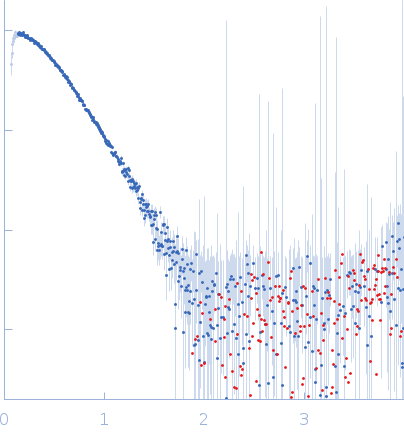
SASDKG4 – Malus domestica double bond reductase (MdDBR) apoform

Malus domestica double bond reductase
MWexperimental 79 kDa
MWexpected 77 kDa
VPorod 110 nm3
log I(s) 9.30×100 9.30×10⁻¹ 9.30×10⁻² 9.30×10⁻³
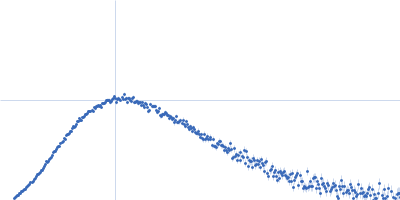
Malus domestica double bond reductase small angle scattering data  s, nm-1
ln I(s)
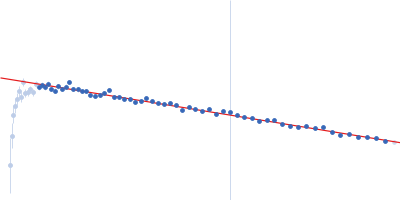
Malus domestica double bond reductase Guinier plot ln 9.30×100 Rg: 3.0 nm 0 (3.0 nm)-2 s2
(sRg)2I(s)/I(0)
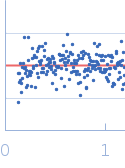
Malus domestica double bond reductase Kratky plot 1.104 0 3 sRg
Dmax: 9.9 nm

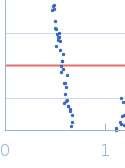
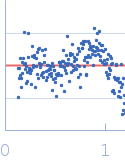
Data validation


Fits and models


log I(s)
 s, nm-1
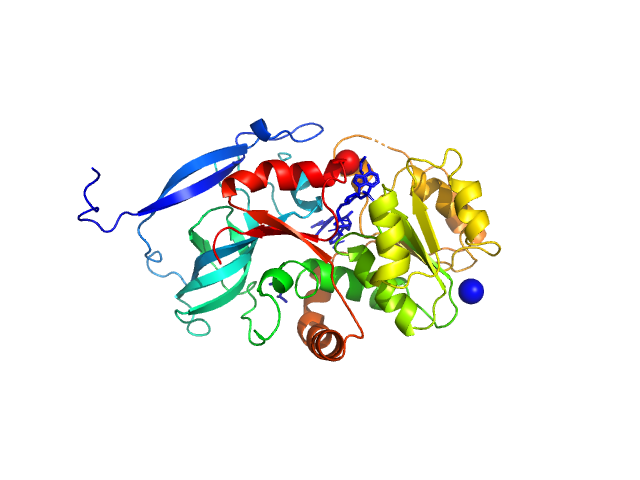
Malus domestica double bond reductase PDB (PROTEIN DATA BANK) model

log I(s)
 s, nm-1
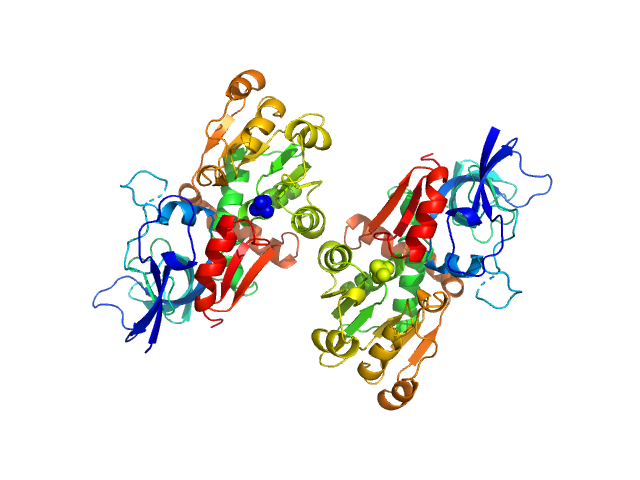
Malus domestica double bond reductase PDB (PROTEIN DATA BANK) model

log I(s)
 s, nm-1
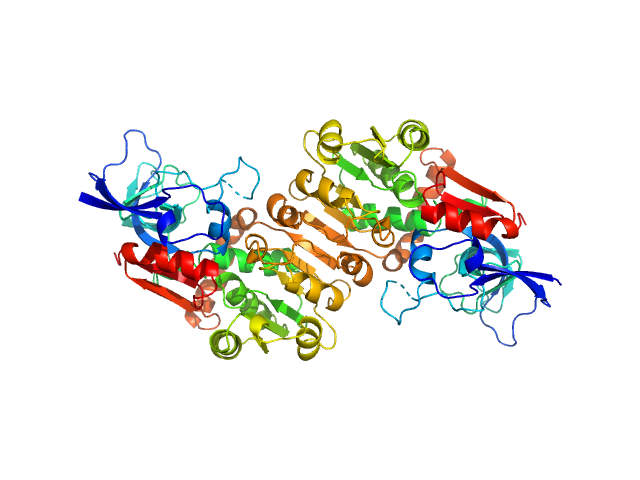
Malus domestica double bond reductase PISA model

SAXS data from solutions of Malus domestica double bond reductase (MdDBR), apoform, in 50 mM Tris-HCl, 100 mM NaCl., pH 7.5 were collected using an Anton Paar SAXSpoint 2.0 instrument equipped with a Eiger R 1M detector (Vestec, Czech Republic) at a sample-detector distance of 0.8 m and at a wavelength of λ = 0.134 nm (I(s) vs s, where s = 4πsinθ/λ, and 2θ is the scattering angle). One solute concentration of 7.00 mg/ml was measured at 20°C. 30 successive 60 second frames were collected. The data were normalized to the intensity of the transmitted beam and radially averaged; the scattering of the solvent-blank was subtracted.

Malus domestica double bond reductase (MdDBR)
Mol. type   Protein
Organism   Malus domestica
Olig. state   Dimer
Mon. MW   38.4 kDa
Sequence   FASTA
 
PDB ID   6YTZ
 
PDB ID   6YSB