Plasmodium falciparum nucleoplasmin (PfNPM)

Ketul Saharan.

SASDVU2 – Nucleoplasmin-like domain-containing protein PfNPM (1-170) - H3/H4 histone oligomer complex

Histone H3.1
PfNPM A3 (1-170)
Histone H4
MWexperimental 151 kDa
MWexpected 156 kDa
VPorod 284 nm3
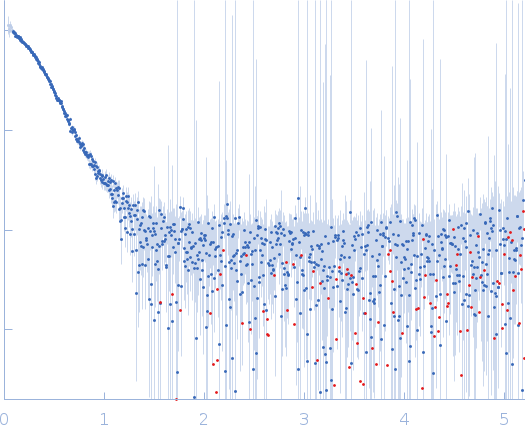
log I(s) 2.80×101 2.80×100 2.80×10⁻¹ 2.80×10⁻²
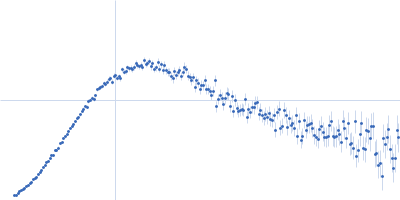
Histone H3.1 PfNPM A3 (1-170) Histone H4 small angle scattering data  s, nm-1
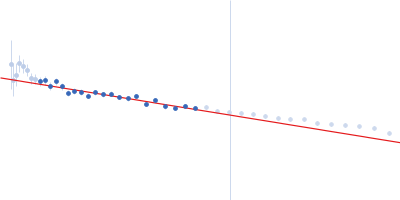
ln I(s)
Histone H3.1 PfNPM A3 (1-170) Histone H4 Guinier plot ln 2.80×101 Rg: 4.9 nm 0 (4.9 nm)-2 s2
(sRg)2I(s)/I(0)
Histone H3.1 PfNPM A3 (1-170) Histone H4 Kratky plot 1.104 0 3 sRg
p(r)
Histone H3.1 PfNPM A3 (1-170) Histone H4 pair distance distribution function Rg: 4.2 nm 0 Dmax: 13.8 nm

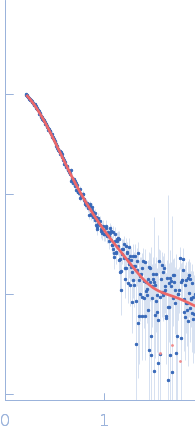
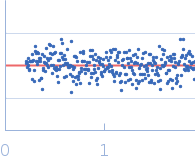
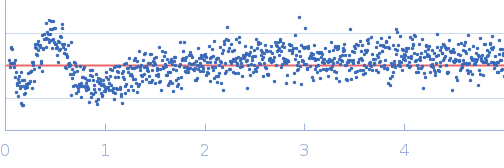
Data validation


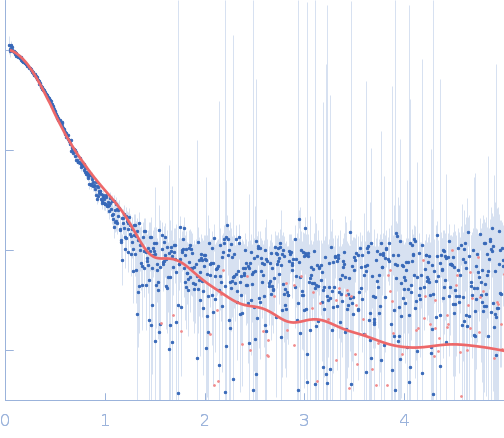
Fits and models


log I(s)
 s, nm-1
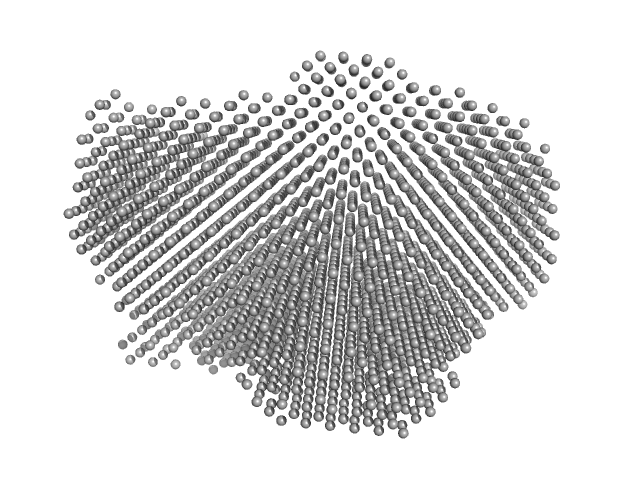
Histone H3.1 PfNPM A3 (1-170) Histone H4 DAMMIN model

log I(s)
 s, nm-1
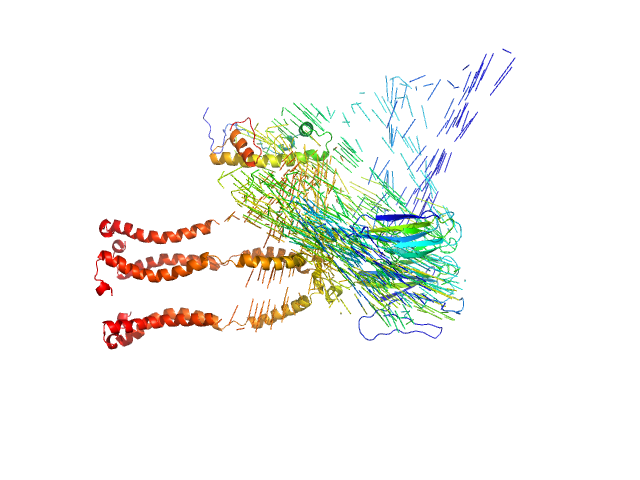
Histone H3.1 PfNPM A3 (1-170) Histone H4 ALPHAFOLD model

Synchrotron SAXS data from solutions of Nucleoplasmin-like domain-containing protein PfNPM (1-170) - H3/H4 histone oligomer complex in 20 mM Tris, 150 mM NaCl, 2 mM β-mercaptoethanol, pH 7.5 were collected on the BM29 beam line at the ESRF storage ring (Grenoble, France) using a Pilatus3 2M detector at a sample-detector distance of 2.9 m and at a wavelength of λ = 0.09794 nm (I(s) vs s, where s = 4πsinθ/λ, and 2θ is the scattering angle). One solute concentration of 1.00 mg/ml was measured at 20°C. 10 successive 20 second frames were collected. The data were normalized to the intensity of the transmitted beam and radially averaged; the scattering of the solvent-blank was subtracted.

Histone H3.1 (Histone H3)
Mol. type   Protein
Organism   Homo sapiens
Olig. state   Dimer
Mon. MW   15.4 kDa
 
UniProt   P68431 (1-136)
Sequence   FASTA
 
PfNPM A3 (1-170) (PfNPM A3)
Mol. type   Protein
Organism   Plasmodium falciparum 3D7
Olig. state   Pentamer
Mon. MW   20.5 kDa
 
UniProt   C0H4U4 (1-170)
Sequence   FASTA
 
Histone H4 (H4)
Mol. type   Protein
Organism   Homo sapiens
Olig. state   Dimer
Mon. MW   11.4 kDa
 
UniProt   P62805 (1-103)
Sequence   FASTA