Breaking new ground into RAD51–BRC repeats interplay in Homologous Recombination

Rinaldi F, Franco P, Veronesi M, Romeo E, Bresciani V, Varignani G, Catalano F, Bernetti M, Masetti M, Langer J, Girotto S, Cavalli A, (2025) DOI

SASDWT5 – N-terminal truncated RAD51 in complex with fourth BRC repeat (BRC4) SEC-SAXS

Breast cancer type 2 susceptibility protein (BRC repeat 4)
DNA repair protein RAD51 homolog 1 (Δ97)
MWexperimental 30 kDa
MWexpected 31 kDa
VPorod 57 nm3
log I(s) 3.98×10⁻² 3.98×10⁻³ 3.98×10⁻⁴ 3.98×10⁻⁵
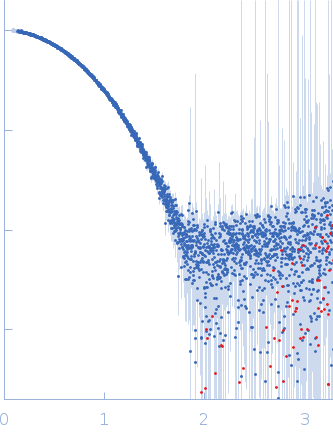
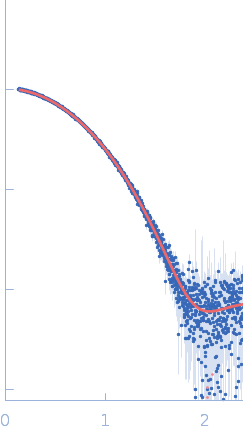
Breast cancer type 2 susceptibility protein (BRC repeat 4) DNA repair protein RAD51 homolog 1 (Δ97) small angle scattering data  s, nm-1
ln I(s)
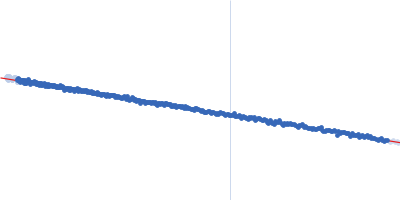
Breast cancer type 2 susceptibility protein (BRC repeat 4) DNA repair protein RAD51 homolog 1 (Δ97) Guinier plot ln 3.99×10⁻² Rg: 2.0 nm 0 (2.0 nm)-2 s2
(sRg)2I(s)/I(0)
Breast cancer type 2 susceptibility protein (BRC repeat 4) DNA repair protein RAD51 homolog 1 (Δ97) Kratky plot 1.104 0 3 sRg
p(r)
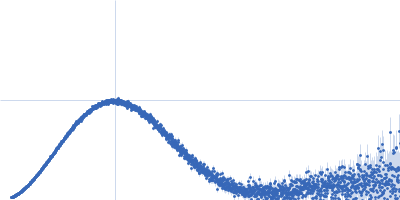
Breast cancer type 2 susceptibility protein (BRC repeat 4) DNA repair protein RAD51 homolog 1 (Δ97) pair distance distribution function Rg: 2.0 nm 0 Dmax: 6.6 nm

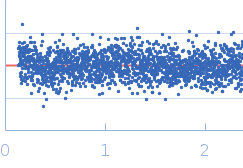
Data validation


Fits and models


log I(s)
 s, nm-1
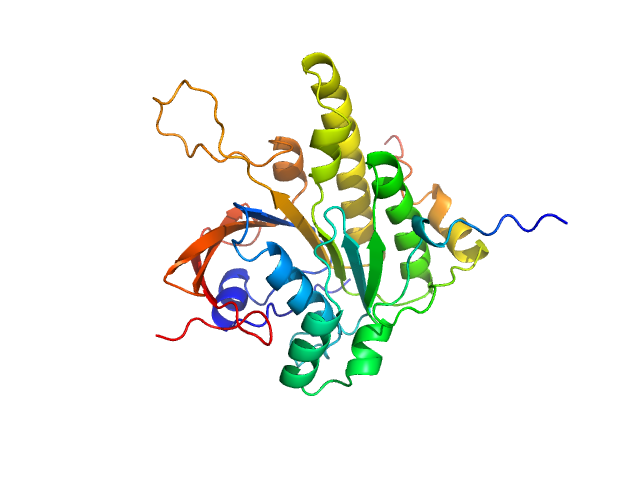
Breast cancer type 2 susceptibility protein (BRC repeat 4) DNA repair protein RAD51 homolog 1 (Δ97) ALPHAFOLD model

Synchrotron SAXS data from solutions of N-terminal truncated RAD51 in complex with fourth BRC repeat (BRC4) SEC-SAXS in 20 mM K₂HPO₄/KH₂PO₄, 100 mM NaCl, 200 mM Li₂SO₄, 1 mM DTT, 2% sucrose, pH 8 were collected on the B21 beam line at the Diamond Light Source storage ring (Didcot, UK) using a Eiger 4M detector at a sample-detector distance of 36.9 m and at a wavelength of λ = 0.09464 nm (I(s) vs s, where s = 4πsinθ/λ, and 2θ is the scattering angle). In-line size-exclusion chromatography (SEC) SAS was employed. The SEC parameters were as follows: A 100.00 μl sample at 6.6 mg/ml was injected at a 0.07 ml/min flow rate onto a Cytiva Superdex 200 Increase 3.2/300 column at 15°C. 600 successive 3 second frames were collected. The data were normalized to the intensity of the transmitted beam and radially averaged; the scattering of the solvent-blank was subtracted.

Molecular weight has been inferred through Volume of Correlation (Vc). Sample molecular weight and monodispersity has been independently confirmed through static light scattering (SLS). 52 successive frames were collected through the sample elution peak (from a total of 600 frames).

Breast cancer type 2 susceptibility protein (BRC repeat 4) (BRC4)
Mol. type   Protein
Organism   Homo sapiens
Olig. state   Monomer
Mon. MW   4.5 kDa
 
UniProt   P51587 (1517-1551)
Sequence   FASTA
 
DNA repair protein RAD51 homolog 1 (Δ97) (Δ97RAD51)
Mol. type   Protein
Organism   Homo sapiens
Olig. state   Monomer
Mon. MW   26.5 kDa
 
UniProt   Q06609 (98-339)
Sequence   FASTA