|
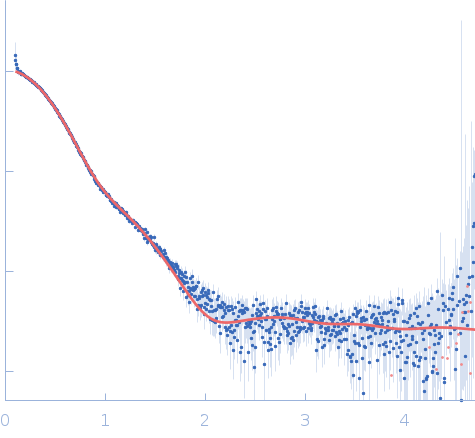
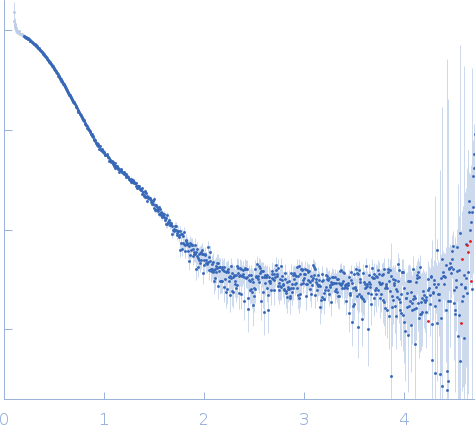
Synchrotron SAXS
data from solutions of
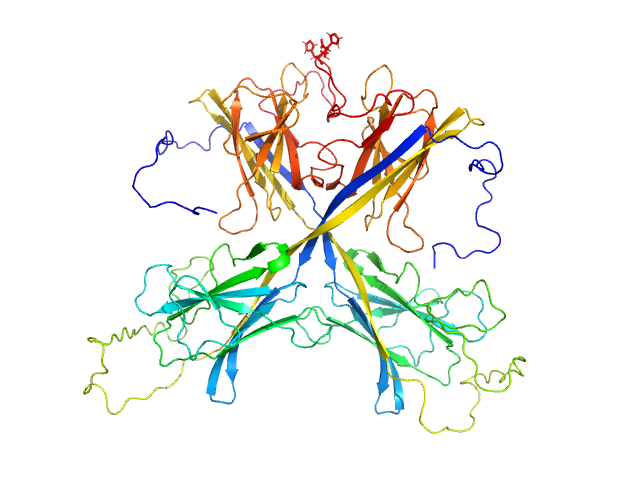
cross-linked carbohydrate binding duplex of AMY3 (alpha-amylase 3)
in
100 mM potassium phosphate, pH 7.4
were collected
on the
12.3.1 (SIBYLS) beam line
at the Advanced Light Source (ALS) storage ring
(Berkeley, CA, USA)
using a Pilatus3 X 2M detector
at a sample-detector distance of 2 m and
at a wavelength of λ = 0.1127 nm
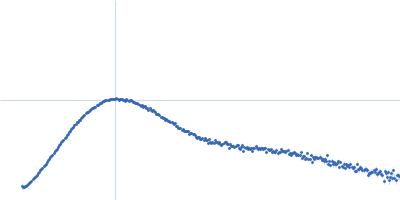
(I(s) vs s, where s = 4πsinθ/λ, and 2θ is the scattering angle).
One solute concentration of 8.00 mg/ml was measured
at 10°C.
40 successive
0.300 second frames were collected.
The data were normalized to the intensity of the transmitted beam and radially averaged; the scattering of the solvent-blank was subtracted.
Cross-linked CBM were shipped overnight on dry ice and analyzed using SEC-SAXS at the SIBYLS beamline at the Advanced Light Source, Lawrence Berkeley National Laboratory, Berkeley, CA. Samples were separated on a Shodex K-W-803 column at a flow rate of 0.5 mL/min at 10 °C, and the eluate was measured in line with UV/vis absorbance at 280 nm, multi-angle X-ray scattering (MALS), and SAXS. The incident light wavelength was 1.127 Å at a sample-to-detector distance of 2.1 m. This setup results in scattering vectors, q, ranging from 0.0114 to 0.4 Å−1, where the scattering vector is defined as q = 4πsin(θ)/λ, with θ being the measured scattering angle.
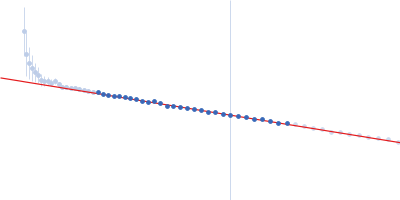
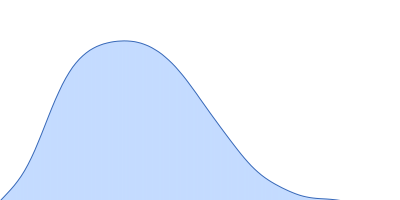
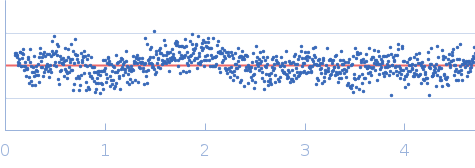
Radially averaged SAXS data files were processed and analyzed in RAW. The radius of gyration (Rg) was calculated for each of the subtracted frames using the Guinier approximation: I(q) = I(0) exp(−q2Rg2/3) with the limits qRg < 1.3. The elution peak was compared to the integral of the ratios to background and Rg relative to the recorded frame using the RAW program. Uniform Rg values across an elution peak represent a homogeneous sample. The final merged SAXS profiles, derived by integrating multiple frames at the elution peak, were used for further analysis. We calculated the Guinier plot to provide information on the aggregation state, the volume of correlation (Vc) to estimate the molecular weight, and the pair distribution function [P(r)] to calculate the maximal inter-particle dimension. Models were fitted to the SAXS data using FOXS and for CBM models refined using BilboMD.
|
|

 s, nm-1