Rinaldi F
Franco P,
Veronesi M,
Romeo E,
Bresciani V,
Varignani G,
Catalano F,
Bernetti M,
Masetti M,
Langer J,
Girotto S,
Cavalli A,
(2025)
DOI
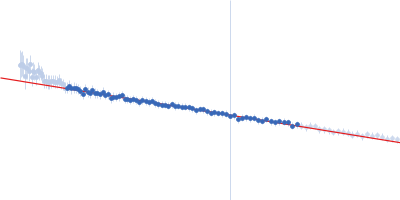
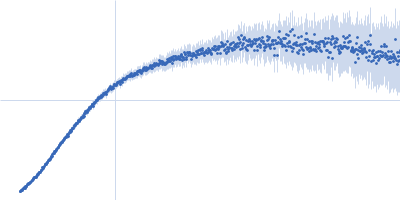
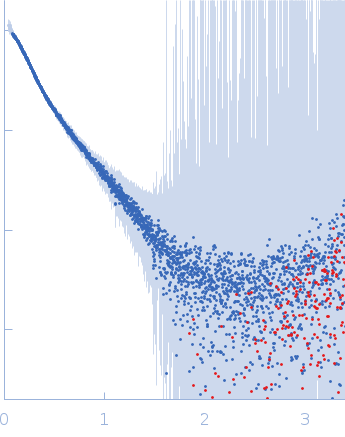
SASDXA5 – DNA repair protein RAD51 homolog 1 (RAD51) [F86E, A89E] in complex with Breast cancer type 2 susceptibility protein (BRCA2) truncation containing the second, third and fourth BRC repeats (BRC2-4) at 2 mg/mL
Synchrotron SAXS
data from solutions of
DNA repair protein RAD51 homolog 1 (RAD51) [F86E, A89E] in complex with Breast cancer type 2 susceptibility protein (BRCA2) truncation containing the second, third and fourth BRC repeats (BRC2-4) at 2 mg/mL
in
20 mM K₂HPO₄/KH₂PO₄, 100 mM NaCl, 200 mM Li₂SO₄, 5% glycerol, 1 mM DTT, pH 8
were collected
on the
B21 beam line
at the Diamond Light Source storage ring
(Didcot, UK)
using a Eiger 4M detector
at a sample-detector distance of 3.7 m and
at a wavelength of λ = 0.09464 nm
(I(s) vs s, where s = 4πsinθ/λ, and 2θ is the scattering angle).
One solute concentration of 2.00 mg/ml was measured
at 15°C.
21 successive
1 second frames were collected.
The data were normalized to the intensity of the transmitted beam and radially averaged; the scattering of the solvent-blank was subtracted.
Molecular weight has been inferred through Volume of Correlation (Vc). Sample molecular weight and monodispersity has been independently confirmed through static light scattering (SLS).

 s, nm-1