The role of kinase domain dimerization in EGFR activation

Zaritza Petrova.

SASDXW4 – EGFR kinase domain duplication mutant (KDD) at 2.7 mg/ml

Receptor protein-tyrosine kinase (duplication mutant)
MWI(0) 75 kDa
MWexpected 80 kDa
VPorod 190 nm3
log I(s) 2.44×10⁻¹ 2.44×10⁻² 2.44×10⁻³ 2.44×10⁻⁴
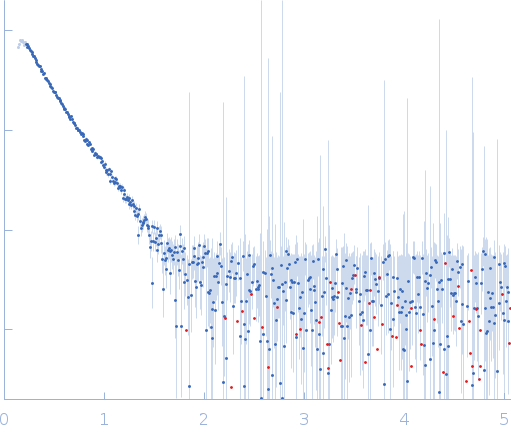
Receptor protein-tyrosine kinase (duplication mutant) small angle scattering data  s, nm-1
ln I(s)
Receptor protein-tyrosine kinase (duplication mutant) Guinier plot ln 2.44×10⁻¹ Rg: 4.5 nm 0 (4.5 nm)-2 s2
(sRg)2I(s)/I(0)
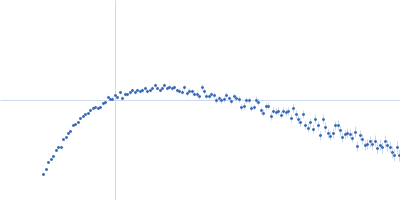
Receptor protein-tyrosine kinase (duplication mutant) Kratky plot 1.104 0 3 sRg
p(r)
Receptor protein-tyrosine kinase (duplication mutant) pair distance distribution function Rg: 4.7 nm 0 Dmax: 14.9 nm

Data validation


There are no models related to this curve.

SAXS data from solutions of EGFR kinase domain duplication mutant in 20 mM HEPES, 250 mM NaCl, 250 mM KCl, pH 8 were collected on the Rigaku MicroMax-007HF instrument (Yale University, New Haven, United States) using a Rigaku PSAXS Nano detector at a sample-detector distance of 0.5 m and at a wavelength of λ = 0.1542 nm (I(s) vs s, where s = 4πsinθ/λ, and 2θ is the scattering angle). One solute concentration of 2.70 mg/ml was measured at 4°C. Three successive 7200 second frames were collected. The data were normalized to the intensity of the transmitted beam and radially averaged; the scattering of the solvent-blank was subtracted.

Receptor protein-tyrosine kinase (duplication mutant) (KDD)
Mol. type   Protein
Organism   Homo sapiens
Olig. state   Monomer
Mon. MW   79.6 kDa
 
UniProt   Q504U8 (651-993)
Sequence   FASTA