Agmatine as the initiating substrate for aspartate semialdehyde-dependent bacterial spermidine biosynthesis.

Ostlund JC, Johnston LA, Pardoe MA, Bustillos IM, Bizzell ML, Jones SJ, Lee DF, McFarlane JS, J Biol Chem 302(11):113570 (2026) Europe PMC

SASDXX9 – Apo Bacteroides fragilis carboxyaminopropylagmatine dehydrogenase

Carboxyaminopropylagmatine dehydrogenase
MWexperimental 74 kDa
MWexpected 89 kDa
VPorod 111 nm3
log I(s) 9.58×10⁻² 9.58×10⁻³ 9.58×10⁻⁴ 9.58×10⁻⁵
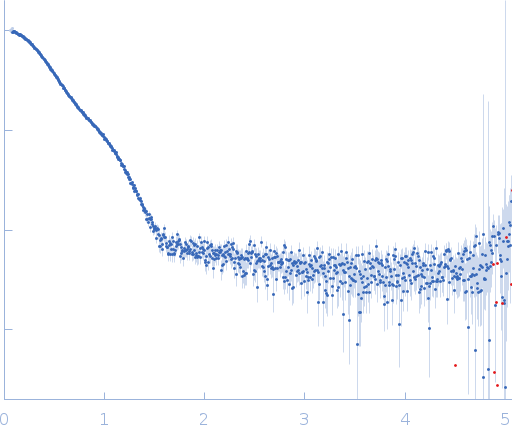
Carboxyaminopropylagmatine dehydrogenase small angle scattering data  s, nm-1
ln I(s)
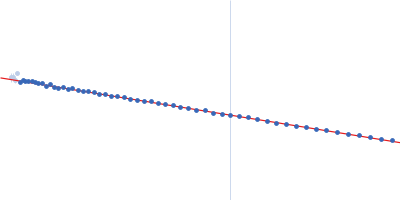
Carboxyaminopropylagmatine dehydrogenase Guinier plot ln 9.59×10⁻² Rg: 3.6 nm 0 (3.6 nm)-2 s2
(sRg)2I(s)/I(0)
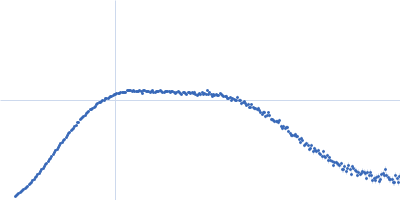
Carboxyaminopropylagmatine dehydrogenase Kratky plot 1.104 0 √3 sRg
p(r)
Carboxyaminopropylagmatine dehydrogenase pair distance distribution function Rg: 3.7 nm 0 Dmax: 11.4 nm

Data validation


There are no models related to this curve.

Synchrotron SAXS data from solutions of Apo Bacteroides fragilis carboxyaminopropylagmatine dehydrogenase in 25mM KPi, 300mM NaCl, 10% Glycerol, 1 mM DTT, pH 8 were collected on the BL4-2 beam line at the Stanford Synchrotron Radiation Lightsource (SSRL) storage ring (Menlo Park, CA, USA) using a Rayonix MX225-HE detector at a sample-detector distance of 1.7 m and at a wavelength of λ = 0.1128 nm (I(s) vs s, where s = 4πsinθ/λ, and 2θ is the scattering angle). One solute concentration of 2.10 mg/ml was measured at 22°C. 10 successive 1 second frames were collected. The data were normalized to the intensity of the transmitted beam and radially averaged; the scattering of the solvent-blank was subtracted.

Carboxyaminopropylagmatine dehydrogenase (CAPADH)
Mol. type   Protein
Organism   [Clostridium] leptum DSM 753
Olig. state   Dimer
Mon. MW   44.6 kDa
 
UniProt   A7VSG1 (1-399)
Sequence   FASTA