Capraro F,
Abis G
Incocciati A,
Simpson PJ,
Karimzadeh M,
Masino L,
Barley A,
Bui TTT,
Kelly G,
Goodarzi H,
Conte MR,
Mardakheh FK,
Nat Commun
(2026)
Europe PMC
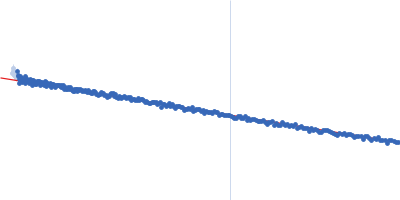
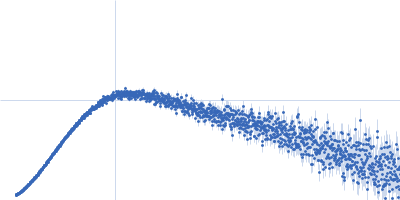
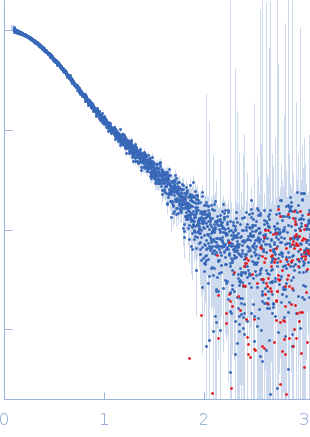
SASDYW5 – La-related protein 6 (LARP6) La-module apo
Synchrotron SAXS
data from solutions of
La-related protein 6 (LARP6) La-module apo
in
25 mM Tris-HCl, 100 mM KCl, 5 mM MgCl2, 1 mM DTT, pH 7.5
were collected
on the
B21 beam line
at the Diamond Light Source storage ring
(Didcot, UK)
using a Eiger 4M detector
at a sample-detector distance of 3.7 m and
at a wavelength of λ = 0.09537 nm
(I(s) vs s, where s = 4πsinθ/λ, and 2θ is the scattering angle).
Solute concentrations ranging between 4 and 5 mg/ml were measured
at 15°C.
600 successive
0.350 second frames were collected.
The data were normalized to the intensity of the transmitted beam and radially averaged; the scattering of the solvent-blank was subtracted.
The low angle data collected at lower concentration were merged with the highest concentration high angle data to yield the final composite scattering curve.
LARP6 La-module, residues 70-300, including the two structured La-motif and RNA-recognition motif 1.
Experimental molecular weight was estimated by SEC-MALLS.

 s, nm-1