Signaling ammonium across membranes through an ammonium sensor histidine kinase.

Pflüger T, Hernández CF, Lewe P, Frank F, Mertens H Svergun D, Baumstark MW, Lunin VY, Jetten MSM, Andrade SLA, Nat Commun 9(1):164 (2018) Europe PMC

SASDCM9 – Ammonium transporter Ks-Amt5

ammonium sensor/transducer
MWexperimental 279 kDa
MWexpected 227 kDa
VPorod 511 nm3
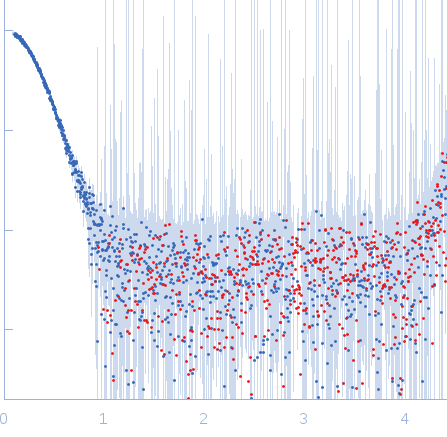
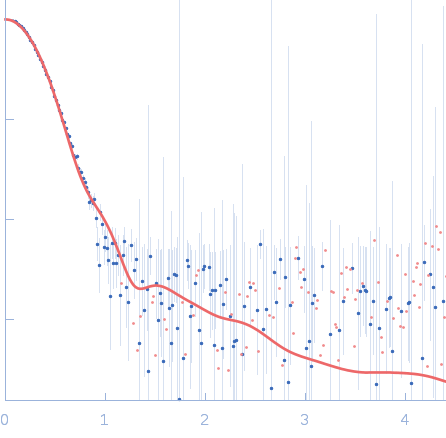
log I(s) 4.70×10² 4.70×101 4.70×100 4.70×10⁻¹
ammonium sensor/transducer small angle scattering data  s, nm-1
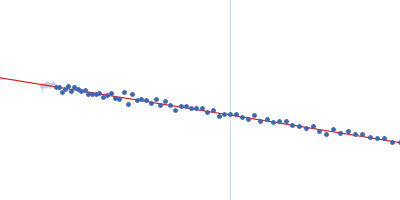
ln I(s)
ammonium sensor/transducer Guinier plot ln 4.70×10² Rg: 4.8 nm 0 (4.8 nm)-2 s2
(sRg)2I(s)/I(0)
ammonium sensor/transducer Kratky plot 1.104 0 3 sRg
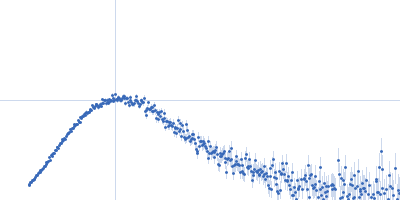
p(r)
ammonium sensor/transducer pair distance distribution function Rg: 4.9 nm 0 Dmax: 17 nm

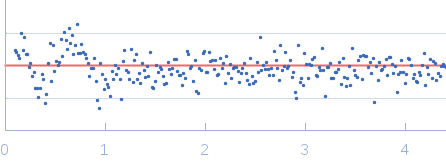
Data validation


Fits and models


log I(s)
 s, nm-1
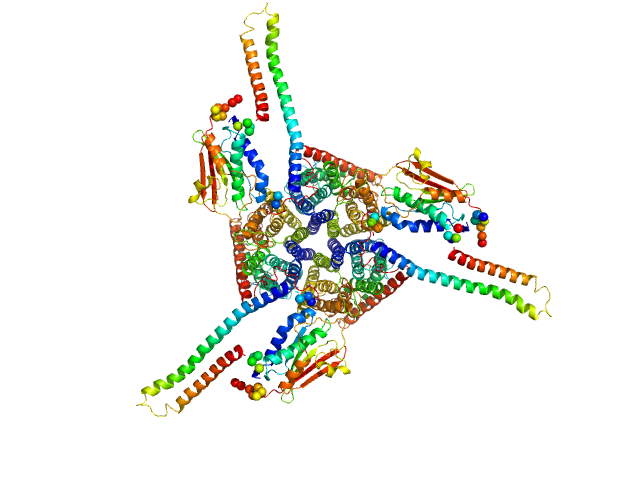
ammonium sensor/transducer CORAL model

Synchrotron SAXS data from solutions of Ammonium transporter Ks-Amt5 in 20 mM Tris/HCl,100 mM NaCl, 5%(w/v) glycerol, 0.09%(w/v) CYMAL-5, pH 8 were collected on the EMBL P12 beam line at the PETRA III storage ring (DESY; Hamburg, Germany) using a Pilatus 2M detector at a sample-detector distance of 2.7 m and at a wavelength of λ = 0.124 nm (I(s) vs s, where s = 4πsinθ/λ, and 2θ is the scattering angle). In-line size-exclusion chromatography (SEC) SAS was employed. The SEC parameters were as follows: A sample at 10 mg/ml was injected onto a column at 10°C. 3600 successive 1 second frames were collected. The data were normalized to the intensity of the transmitted beam and radially averaged; the scattering of the solvent-blank was subtracted.

MW estimate from excluded volume (DAMMIN)

ammonium sensor/transducer (Ks-Amt5)
Mol. type   Protein
Organism   Candidatus Kuenenia stuttgartiensis
Olig. state   Trimer
Mon. MW   75.5 kDa
 
UniProt   Q1Q357
Sequence   FASTA