Human stress-inducible Hsp70 has a high propensity to form ATP-dependent antiparallel dimers that are differentially regulated by co-chaperone binding.

Trcka F, Durech M, Vankova P, Chmelik J, Martinkova V, Hausner J, Kadek A, Marcoux J, Klumpler T Vojtesek B, Muller P, Man P, Mol Cell Proteomics (2018) Europe PMC

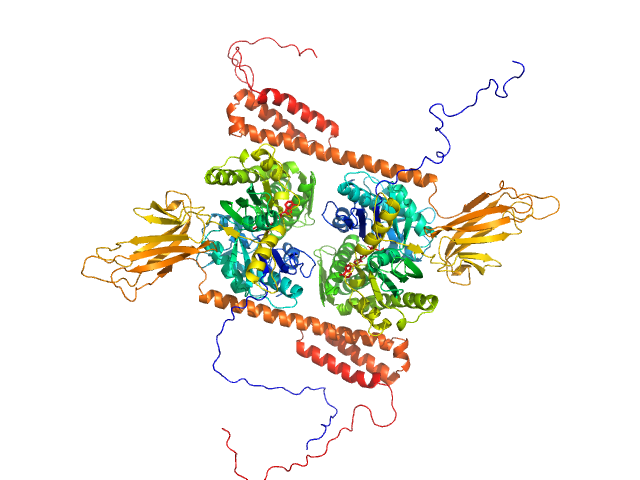
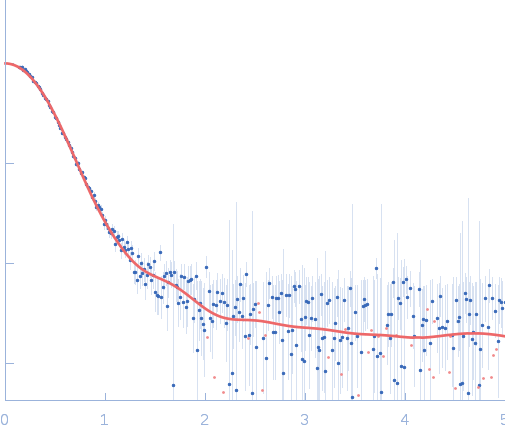
SASDDN6 – Human stress-inducible heat shock 70 kDa protein 1, Hsp70 (Hspa1a) T204A mutant dimer, in the presence of ATP

Heat shock 70 kDa protein 1
MWexperimental 148 kDa
MWexpected 147 kDa
VPorod 248 nm3
log I(s) 7.60×10⁻¹ 7.60×10⁻² 7.60×10⁻³ 7.60×10⁻⁴
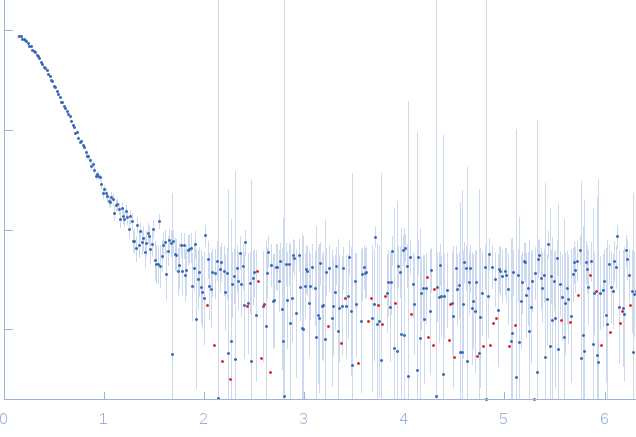
Heat shock 70 kDa protein 1 small angle scattering data  s, nm-1
ln I(s)
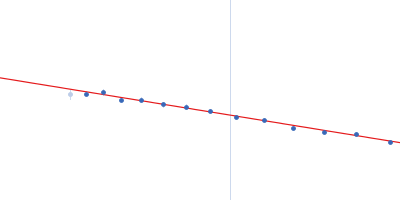
Heat shock 70 kDa protein 1 Guinier plot ln 7.60×10⁻¹ Rg: 4.0 nm 0 (4.0 nm)-2 s2
(sRg)2I(s)/I(0)
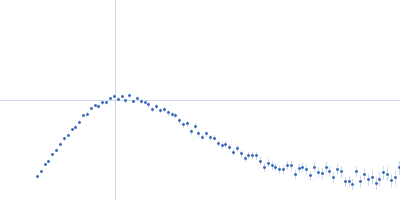
Heat shock 70 kDa protein 1 Kratky plot 1.104 0 3 sRg
p(r)
Heat shock 70 kDa protein 1 pair distance distribution function Rg: 4.0 nm 0 Dmax: 11.6 nm

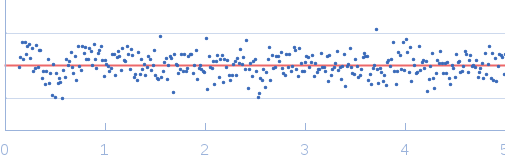
Data validation


Fits and models


log I(s)
 s, nm-1
Heat shock 70 kDa protein 1 MODELLER model

SAXS data from solutions of human stress-induced heat shock 70 kDa protein 1 ,Hsp70, (Hspa1a T204A mutant), with ATP in 50mM HEPES; 150mM KCH3COO; 2mM MgCl2, pH 7.5, were collected on a Rigaku BioSAXS-1000 instrument at CEITEC (Brno, Czech Republic) using a Pilatus 100K detector at a sample-detector distance of 0.5 m and at a wavelength of λ = 0.154 nm (l(s) vs s, where s = 4πsinθ/λ, and 2θ is the scattering angle). One solute concentration of 2.50 mg/ml was measured at 4°C. The data were normalized to the intensity of the transmitted beam and radially averaged; the scattering of the solvent-blank was subtracted.

Number of frames = UNKNOWN

Heat shock 70 kDa protein 1 (HSPA1A_T204A)
Mol. type   Protein
Organism   Homo sapiens
Olig. state   Dimer
Mon. MW   73.7 kDa
 
UniProt   P0DMV8
Sequence   FASTA