Intramolecular structural heterogeneity altered by long-range contacts in an intrinsically disordered protein.

Koren G, Meir S Holschuh L, Mertens HDT, Ehm T, Yahalom N, Golombek A, Schwartz T, Svergun DI, Saleh OA, Dzubiella J, Beck R, Proc Natl Acad Sci U S A 120(30):e2220180120 (2023) Europe PMC

SASDSC3 – Segment S(66-81) of the Neurofilament low intrinsically disordered tail domain

Segment S(66-81) of the Neurofilament low intrinsically disordered tail domain
MWexperimental 2 kDa
MWexpected 2 kDa
log I(s) 6.77×10² 6.77×101 6.77×100 6.77×10⁻¹
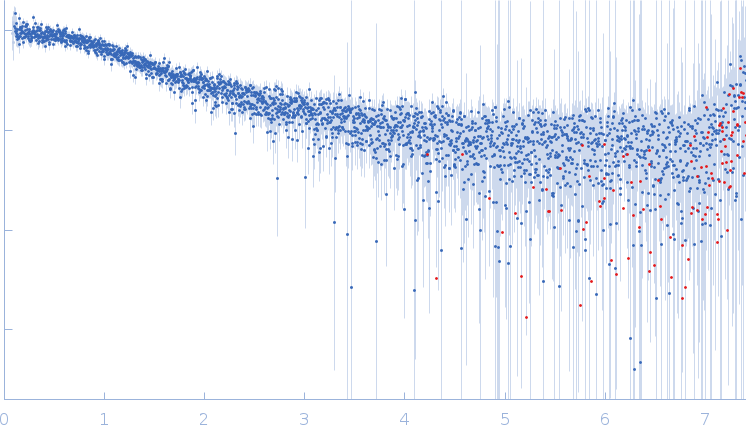
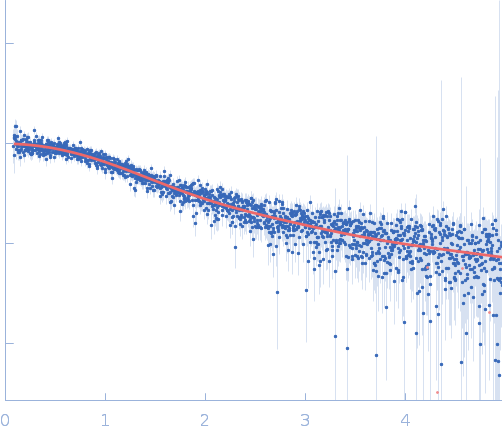
Segment S(66-81) of the Neurofilament low intrinsically disordered tail domain small angle scattering data  s, nm-1
ln I(s)
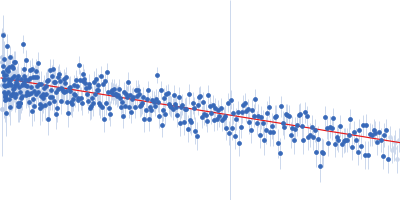
Segment S(66-81) of the Neurofilament low intrinsically disordered tail domain Guinier plot ln 6.77×10² Rg: 1.1 nm 0 (1.1 nm)-2 s2
(sRg)2I(s)/I(0)
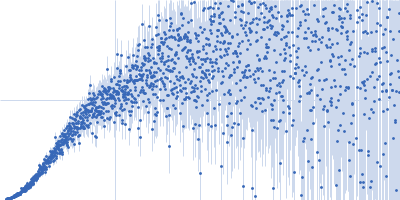
Segment S(66-81) of the Neurofilament low intrinsically disordered tail domain Kratky plot 1.104 0 3 sRg

Data validation


Fits and models


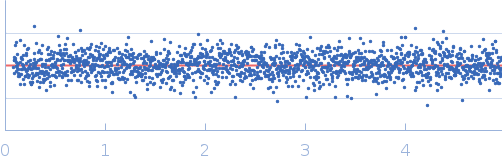
log I(s)
 s, nm-1
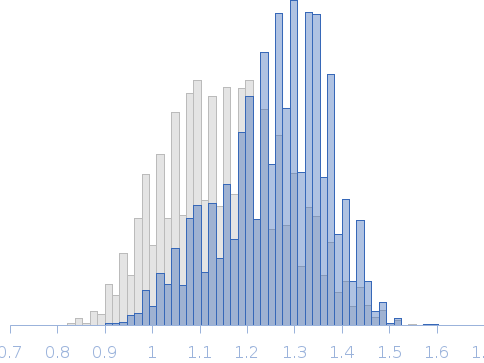
Segment S(66-81) of the Neurofilament low intrinsically disordered tail domain Rg histogram Rg, nm

Synchrotron SAXS data from solutions of Segment S(66-81) of the Neurofilament low intrinsically disordered tail domain in 20 mM Tris, pH 8 were collected on the EMBL P12 beam line at the PETRA III storage ring (DESY; Hamburg, Germany) using a Pilatus 6M detector at a sample-detector distance of 3 m and at a wavelength of λ = 0.124 nm (I(s) vs s, where s = 4πsinθ/λ, and 2θ is the scattering angle). One solute concentration of 3.00 mg/ml was measured at 10°C. The data were normalized to the intensity of the transmitted beam and radially averaged; the scattering of the solvent-blank was subtracted.

Number of frames = UNKNOWN

Tags: idp
Segment S(66-81) of the Neurofilament low intrinsically disordered tail domain (S(66-81))
Mol. type   Protein
Organism   house mouse
Olig. state   Monomer
Mon. MW   1.8 kDa
Sequence   FASTA