The Chlamydia pneumoniae effector SemD exploits its host’s endocytic machinery by structural and functional mimicry

Kocher F, Applegate V, Reiners J Port A, Spona D, Hänsch S, Mirzaiebadizi A, Ahmadian M, Smits S, Hegemann J, Mölleken K, Nature Communications 15(1) (2024) DOI

SASDTR5 – BR-GBD (apo form of actin nucleation-promoting factor WASL)

Actin nucleation-promoting factor WASL
MWexperimental 19 kDa
MWexpected 19 kDa
VPorod 19 nm3
log I(s) 4.56×10² 4.56×101 4.56×100 4.56×10⁻¹
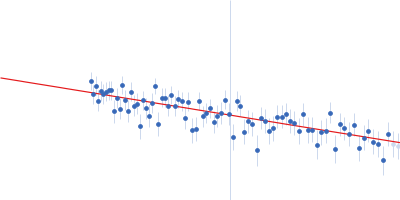
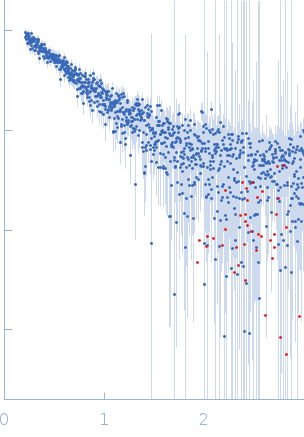
Actin nucleation-promoting factor WASL small angle scattering data  s, nm-1
ln I(s)
Actin nucleation-promoting factor WASL Guinier plot ln 4.56×10² Rg: 3.0 nm 0 (3.0 nm)-2 s2
(sRg)2I(s)/I(0)
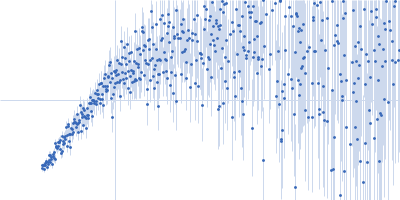
Actin nucleation-promoting factor WASL Kratky plot 1.104 0 3 sRg
p(r)
Actin nucleation-promoting factor WASL pair distance distribution function Rg: 2.9 nm 0 Dmax: 9.9 nm

Data validation


There are no models related to this curve.

Synchrotron SAXS data from solutions of BR-GBD in 137 mM NaCl, 2.7 mM KCl, 10 mM Na2HPO4, 1.8 mM KH2PO4, 3% glycerol, pH 8.5 were collected on the EMBL P12 beam line at PETRA III (DESY; Hamburg, Germany) using a Pilatus 6M detector at a sample-detector distance of 3 m and at a wavelength of λ = 0.124 nm (I(s) vs s, where s = 4πsinθ/λ, and 2θ is the scattering angle). In-line size-exclusion chromatography (SEC) SAS was employed. The SEC parameters were as follows: A 100.00 μl sample at 10 mg/ml was injected at a 0.60 ml/min flow rate onto a GE Superdex 200 Increase 10/300 column at 20°C. 2400 successive 0.995 second frames were collected. The data were normalized to the intensity of the transmitted beam and radially averaged; the scattering of the solvent-blank was subtracted.

Actin nucleation-promoting factor WASL (BR-GBD)
Mol. type   Protein
Organism   Rattus norvegicus
Olig. state   Monomer
Mon. MW   19.5 kDa
 
UniProt   O08816 (141-273)
Sequence   FASTA