Dynamics and structural features of the eEF1A1 and eEF1A2 paralogs

Novosylna O, Shalak V, Dąbrowska K, Patmanidis I, Lozhko D Bondarchuk T, Schiøtt B, Pedersen J, Knudsen C, Nissen P, Dadlez M, Negrutskii B, Nucleic Acids Research 53(21) (2025) DOI

SASDXH2 – Mammalian translation elongation factor eEF1A2

Mammalian translation elongation factor eEF1A2
MWI(0) 63 kDa
MWexpected 50 kDa
VPorod 60 nm3
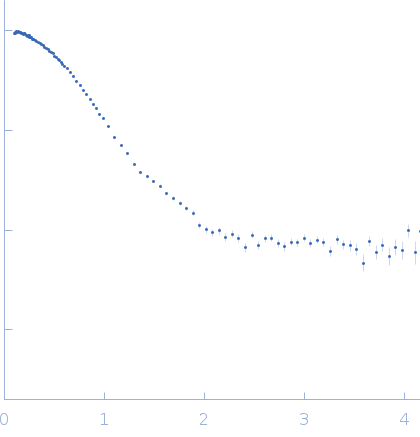
log I(s) 7.98×10⁻² 7.98×10⁻³ 7.98×10⁻⁴ 7.98×10⁻⁵
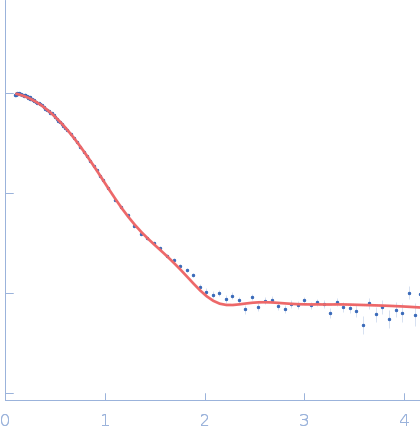
Mammalian translation elongation factor eEF1A2 small angle scattering data  s, nm-1
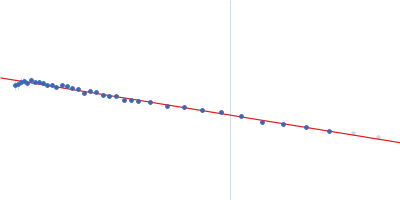
ln I(s)
Mammalian translation elongation factor eEF1A2 Guinier plot ln 7.99×10⁻² Rg: 2.6 nm 0 (2.6 nm)-2 s2
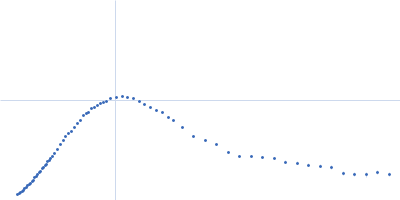
(sRg)2I(s)/I(0)
Mammalian translation elongation factor eEF1A2 Kratky plot 1.104 0 3 sRg
p(r)
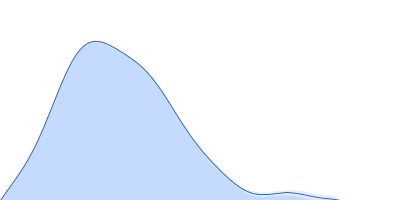
Mammalian translation elongation factor eEF1A2 pair distance distribution function Rg: 26.7 nm 0 Dmax: 97.1 nm

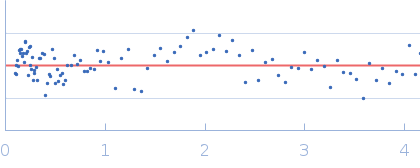
Data validation


Fits and models


log I(s)
 s, nm-1
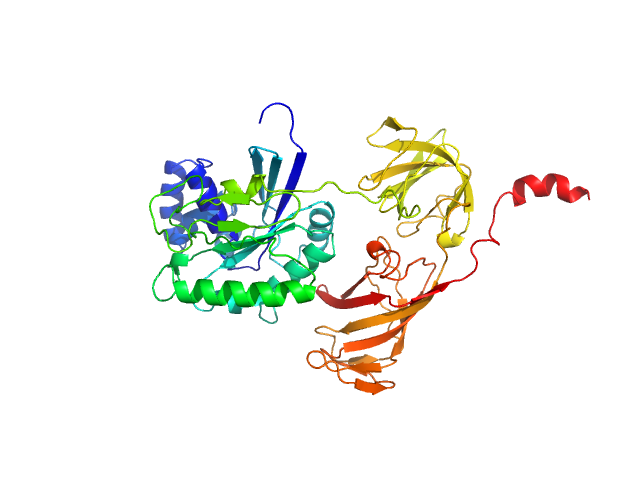
Mammalian translation elongation factor eEF1A2 CHIMERA model

SAXS data from solutions of Mammalian translation elongation factor eEF1A2 in 25 mM Tris HCl, 150 mM NaCl, 6 mM βME, 20% glycerol, 0.01mM GDP,, pH 7.5 were collected on the Bruker Nanostar w Excillum source instrument (Department of Chemistry, iNANO building, Aarhus Uinversity, Aarhus C, Denmark) using a VÅNTEC-2000 detector at a sample-detector distance of 0.9 m and at a wavelength of λ = 0.134 nm (I(s) vs s, where s = 4πsinθ/λ, and 2θ is the scattering angle). One solute concentration of 1.90 mg/ml was measured at 20°C. One 1800 second frame was collected. The data were normalized to the intensity of the transmitted beam and radially averaged; the scattering of the solvent-blank was subtracted.

Mammalian translation elongation factor eEF1A2
Mol. type   Protein
Olig. state   Monomer
Mon. MW   50.5 kDa
 
UniProt   Q05639 (1-463)
Sequence   FASTA