Integrative modeling of guanylate binding protein dimers

Schumann W, Loschwitz J, Reiners J Degrandi D, Legewie L, Stühler K, Pfeffer K, Poschmann G, Smits S, Strodel B, Protein Science (2023) DOI

SASDLY9 – Mouse guanylate-binding protein 7 - mGBP7

Gbp6 protein (Gbp7 - Gbp6 protein Mus musculus)
MWI(0) 137 kDa
MWexpected 148 kDa
VPorod 176 nm3
log I(s) 9.92×10⁻³ 9.92×10⁻⁴ 9.92×10⁻⁵ 9.92×10⁻⁶
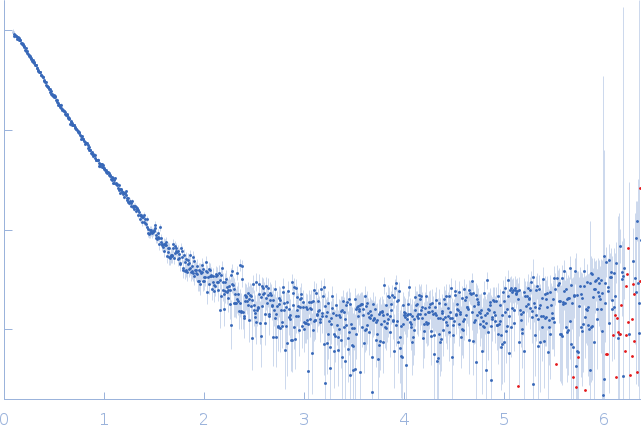
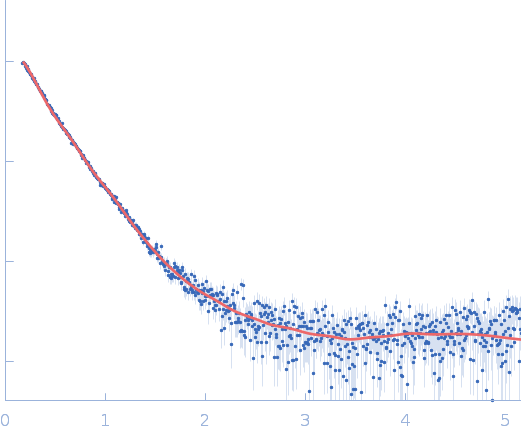
Gbp6 protein (Gbp7 - Gbp6 protein Mus musculus) small angle scattering data  s, nm-1
ln I(s)
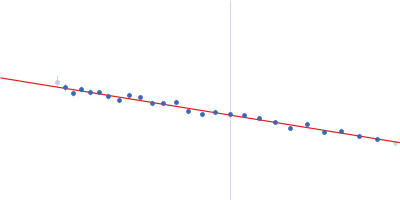
Gbp6 protein (Gbp7 - Gbp6 protein Mus musculus) Guinier plot ln 9.93×10⁻³ Rg: 5.4 nm 0 (5.4 nm)-2 s2
(sRg)2I(s)/I(0)
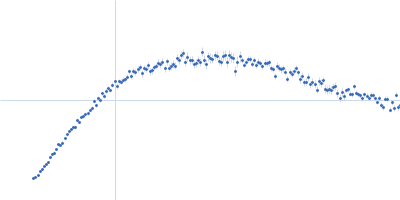
Gbp6 protein (Gbp7 - Gbp6 protein Mus musculus) Kratky plot 1.104 0 3 sRg
p(r)
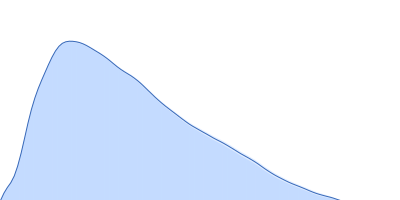
Gbp6 protein (Gbp7 - Gbp6 protein Mus musculus) pair distance distribution function Rg: 5.1 nm 0 Dmax: 17 nm

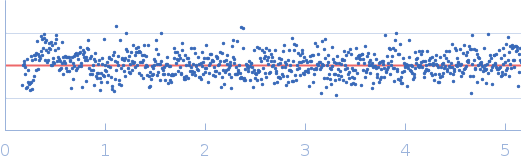
Data validation


Fits and models


log I(s)
 s, nm-1
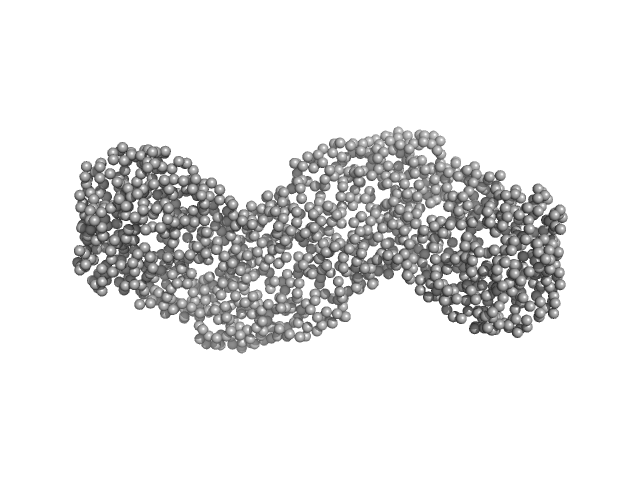
Gbp6 protein (Gbp7 - Gbp6 protein Mus musculus) GASBOR model

SAXS data from solutions of mouse guanylate-binding protein 7 (mGBP7) in 50 mM Tris, 5 mM MgCl, 2 mM DTT, pH 8 were collected using a Xenocs Xeuss 2.0 Q-Xoom instrument (Center for Structural Studies, Heinrich-Heine-University, Düsseldorf Germany) equipped with a Pilatus3 R 300K detector at a sample-detector distance of 0.6 m and at a wavelength of λ = 0.154 nm (I(s) vs s, where s = 4πsinθ/λ, and 2θ is the scattering angle). Solute concentrations ranging between 1.7 and 6.9 mg/ml were measured at 10°C. Six successive 600 second frames were collected. The data were normalized to the intensity of the transmitted beam and radially averaged; the scattering of the solvent-blank was subtracted. The low angle data collected at lower concentration were merged with the highest concentration high angle data to yield the final composite scattering curve.

Gbp6 protein (Gbp7 - Gbp6 protein Mus musculus) (mGbp7)
Mol. type   Protein
Organism   Mus musculus
Olig. state   Dimer
Mon. MW   73.8 kDa
 
UniProt   Q91Z40 (2-638)
Sequence   FASTA